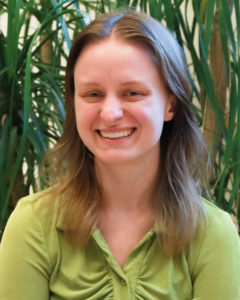
 This post was written by Sara Hansen, who attended the 2025 DLF Forum as an Emerging Professionals Fellow. The views and opinions expressed in this blog post are solely those of the author and do not necessarily reflect the official policy or position of the Digital Library Federation or CLIR. 2025 Emerging Professionals Fellowships were supported by a grant from MetaArchive.
Sara Hansen is the Research Data Curator for the Purdue University Research Repository (PURR). Their background is in open, data-intensive ecological research, which was a natural stepping stone toward their dream digital libraries career. Sara’s favorite part of their job is exploring a wide variety of research projects across Purdue’s campus by working hands-on with the data they use and generate. Sara is excited to expand their understanding of information science and make lots of new connections at the DLF Forum.
An Ecologist Goes to DLF Forum (or, why you should try the thing you want to try, even if you don’t think you can)
I started my first libraries job only a few months before the 2025 DLF Forum, so I was initially a little nervous to attend. As a data curator at a university focused heavily on biology and agriculture, my background in ecology[1] translates directly to my position; in the overall libraries space, however, I sometimes feel like a fish out of water. Can someone from an entirely different discipline fit in at a conference full of supersmart digital libraries people?
The answer is yes, and I can see now that it is entirely by design. In a word, the DLF Forum was unpretentious. Whereas some conferences can leave you feeling confused and inadequate, I was pleasantly surprised to find myself feeling the opposite. Even though I had a fraction of the experience of most of the presenters and other attendees, the sessions left me with a feeling of “I can probably figure that out.” Presenters welcomed us into their world, leading with “Here is what I know because I’ve made the mistakes” and offering to make space and provide help. Many presenters requested feedback from beginners and experts alike. Common academic problems like name-dropping, overuse of buzzwords, and unexplained acronyms were few and far between. I even kept a running list of “basic” vocabulary and acronyms that were explicitly defined by presenters (everything from GitHub to headless browsers to OAIS) and was shocked at how long it got. While I probably could have guessed that information professionals would be really good at conveying information in an accessible way, it was refreshing to experience firsthand. Is “a fish in water” a real phrase?
I came away from the conference with not only a positive feeling but an actionable list of things to help me grow as a libraries professional and individual. My reading list grew to include Hood Feminism and Data Feminism, I found the perfect Carpentries workshops to build skills I’ve been meaning to work on, and I bookmarked the Data Advocacy for All Toolkit for the next time I need to teach something new.
My point: If a conference skeptic like me can feel genuinely inspired by a conference, you and I can both finally learn Python. Whatever it is you’ve been meaning to try, I believe you can do it. Find a starting point somewhere in the Forum notes and presentations. If somehow you fail, it will make a great talk for next year’s Forum.
My other point: If you are one of the people saying “National Science Foundation” instead of “NSF” and explaining what a hashtag is even when it feels weird, please keep doing it! You are building vitally important on-ramps, and I’m grateful for that extra work.
[1] If you’re wondering why I’m not a field ecologist now, picture someone who got lost at the airport, lost in downtown Denver, and lost in the hotel all before the opening plenary trying to navigate a complex wetland ecosystem.