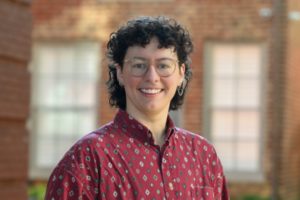
 This post was written by Dorian McIntush, who attended the 2025 DLF Forum as an Emerging Professionals Fellow. The views and opinions expressed in this blog post are solely those of the author and do not necessarily reflect the official policy or position of the Digital Library Federation or CLIR. 2025 Emerging Professionals Fellowships were supported by a grant from MetaArchive.
Dorian McIntush is the Open Scholarship and Data Resident Librarian at Washington and Lee University, where he supports faculty and students with digital research and open knowledge initiatives. He has a commitment to creating equitable access to knowledge and is particularly interested in exploring the environmental impact of digital technologies and open scholarship models that prioritize accessibility and long-term sustainability. Beyond his professional work, he enjoys tromping through Virginia’s hiking trails with his dog, taking on new knitting projects, and cooking interesting recipes for dinner.
When I stepped into my current role of Data and Open Scholarship Resident Librarian at Washington and Lee University in July of this year, I was also stepping for the first time into the world of academic libraries. I focused on public libraries during my MLIS and after graduation I worked at the DC Public Library. My new academic librarian position was also brand new at my institution and was constructed to be a librarian residency. This meant that I would have a lot of freedom to grow into and shape the role, but also no real history to use as a support and learn from. This was simultaneously a gift and also a little daunting.
Coming from public libraries, I had grown used to thinking about access in very practical, immediate terms. Who has a library card? Who can physically get to our building? What barriers keep people from the resources they need? But the sessions at DLF pushed me to think about access in ways that felt more expansive.
Amber Dierking’s presentation on the Queer Liberation Library was a particular highlight for me. I’d already been a user and huge fan of QLL, but hearing Dierking talk about the work behind it reinforced everything I loved about their approach. QLL didn’t reinvent the wheel. They focused on using existing tools, keeping it simple, making it free. As someone building a role from scratch, the creative pragmatism of QLL felt like a blueprint I could make use of.
I was also drawn to Mariam Ismail’s presentation on the 23/54 Project. The work of preserving a community quilt through 3D scanning and building an interactive digital exhibit felt like a perfect example of what digital humanities could be at its best: deeply rooted in community, respectful of material culture, and genuinely expanding access rather than just digitizing for digitization’s sake. It made me think about the special collections and archives at my own institution and how we might engage descendant communities and students in similar ways.
The Data Advocacy for All Toolkit presentation tied these threads together for me in a way I didn’t expect. The team was talking about who gets to tell stories with data, who gets left out of those stories, and how we can teach people to use data ethically for social change. This toolkit offered a framework that felt aligned with my public library values, one that’s accessible, focused on equity, and designed to empower data users and learners.
DLF gave me permission to think big while starting small. I’m returning to W&L with a clearer sense of what this residency could become, not a replica of someone else’s role, but something shaped by the communities I serve and the values I bring from public libraries into this new academic space.