
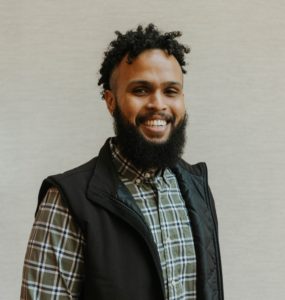
 This post was written by Amaobi Otiji, who attended the 2025 DLF Forum as a Student Fellow. The views and opinions expressed in this blog post are solely those of the author and do not necessarily reflect the official policy or position of the Digital Library Federation or CLIR. 2025 Student Fellowships were supported by a grant from MetaArchive.
Amaobi Otiji is pursuing his Master of Information at Rutgers University concentrating in the Technology, Information, and Management pathway. Prior to entering this program, Amaobi earned a bachelor’s degree in history from Howard University and has worked in roles involving federal collections, both digitized and born-digital. His professional interests center on digital curation, metadata development, and exploring new approaches to preserving and sharing underrepresented histories. He is focused on increasing equitable access to information and helping to shape how emerging technologies influence our cultural memory. In his spare time, Amaobi enjoys playing baritone ukulele, attending live theater, and playing video games.
Digital Memory Work Across Regions and Histories: Reflections on Community-Driven Projects
As I attended this year’s DLF Forum, I kept returning to two themes that resonated with me across multiple different presentations: community engagement and the quiet connective work that builds the infrastructure for it. Two of the sessions I attended during the conference stood out to me in particular because they approached these ideas from different perspectives but utilized similar underlying practices for catering their projects to their communities’ needs. These sessions were about the HBCU Digital Library Trust and the Borderlands storytelling initiative. Both of these projects work with different kinds of communities, rooted in distinct histories spread across North America. Yet all of them demonstrated how effective digital stewardship can be when community engagement is built into the planning of a project rather than treated as a final step at the end.
The Historically Black Colleges and Universities (HBCU) Digital Library trust session outlined a fantastic model that was centered on providing long term support for HBCUs and their unique archival histories. Their emphasis on shared ownership reflected a great understanding of these institutions and their historical challenges trying to navigate limited resources, public scrutiny, and a society that too often worked against them. What stood out to me in particular was how intentional their approach felt. Rather than expecting HBCUs to adapt to them, they adapted to the HBCUs by meeting them where they were. The Trust, hosted by the Atlanta University Center’s Woodruff Library, focused on building capacity in ways that supported institutional autonomy and reflected the needs of the communities they were trying to serve. Their model felt refreshing, informed and grounded in culturally informed practices that support long term institutional resilience.
The Borderlands storytelling session approached their community engagement from another direction. Their work seemed shaped by the layered histories and cultural dynamics found in the U.S.-Mexico Borderlands and by the University of Arizona’s position as a Hispanic-Serving Institution (HSI) with ties to the region. Their presentation drew from movements, identities, and complex narratives that define the region as well as from the data intensive methods they were using to support the work. They spoke about their efforts mapping, visualizing, and other forms of data storytelling that were central to how researchers were interpreting that complexity. What especially stood out to me was how they treated their approach to “place” as more than a backdrop. It functioned as a structure that was allowed to shape the research itself and set the terms for how they partnered with their researchers. It felt rooted in the region in a way that kept the work responsive so that it could move across research, teaching, and student engagement while still staying grounded in the histories and contexts that give it direction.
Across both of the sessions, I found myself thinking about how our community and networks shape our digital memory work every day. The HBCU Digital Library Trust and the Borderlands initiative each operate within distinct historical and cultural environments, yet they are undeniably interconnected through their commitment to engagement shaped by the histories and needs of the communities they serve. Together, these sessions were a great illumination of how digital memory work is always anchored somewhere and shaped by places, relationships, and shared histories that give it meaning. For those hoping to steward this work, our role is to listen closely enough that those anchors guide the paths we build.