 This post was written by Stanislava Gardasevic, who attended the 2025 DLF Forum as an Emerging Professionals Fellow. The views and opinions expressed in this blog post are solely those of the author and do not necessarily reflect the official policy or position of the Digital Library Federation or CLIR. 2025 Emerging Professionals Fellowships were supported by a grant from MetaArchive.
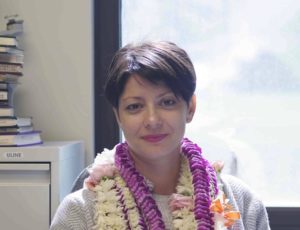
Stanislava (Stasha) Gardasevic works as a Metadata Librarian in Hamilton Library, University of Hawaiʻi at Mānoa (UHM), and her focus is on the description of digital objects. She obtained her PhD in the Communication and Information Sciences (CIS) interdisciplinary program. She holds an MLIS degree from the Digital Library Learning program (joint degree from Norway, Estonia, and Italy) and specializes in metadata for digital resources and interoperability. Her bachelor’s degree is in LIS from the University of Belgrade, Serbia, where she worked at the National Library of Serbia in the digitization department. Stasha was engaged in several digitization projects of historical archives in Hawaiʻi (i.e., Kawaiahaʻo Church, Congressional Papers) and worked as a teaching assistant/course instructor at the Library and Information Science (LIS) at UHM.
Emerging Professional at DLF 2025: Exploring the Migration Pathways
Almost 15 years ago, I was a new professional, fresh out of MLIS and into the National Library of Serbia. After five years working there on metadata for digital libraries, I decided to go back to school, this time in Hawaii 🌴. After taking a scenic route to finish my PhD, I’m back in the metadata role working with digital collections (in Hamilton Library, at University of Hawaiʻi at Mānoa)- but this time in a completely different context and country, so I consider myself a newbie! Thanks to DLF fellowship I was able to bridge the gap every emerging professional has: to meet new people and to learn about the systems that are used across the continent- but especially, the migration stories I will reflect upon!
The first session that I attended related to this topic was “DAM’ed if You Do, DAM’ed if You Don’t: Using Generative AI to Support a Digital Asset Manager Migration”, where the Digital Initiatives Librarian R.C. Miessler from Gettysburg College had a fantastically informative and humorous, almost-standup-performance quality, presentation on his activities that are often required when migrating to a new platform. This presentation was about using ChatGPT as a helper for a non-programmer to develop scripts to perform tasks such as renaming files to IDs, moving images into compound objects, wrangling metadata, and similar. A good takeaway was not to try to use it for OpenRefine GREL, as it hallucinates commands and syntax, and to use SMARTER prompt engineering.
Also, I attended the panel named “Challenges and Opportunities in Migrating to a Modern Digital Collection Platform”, during which we could hear experiences from three librarians from different universities, who switched to Islandora from either the older Islandora version or DSpace. It was interesting to hear that some of these institutions took either a long time to migrate or are still in the migration process, prioritizing the most heavily used materials. It was encouraging to learn that this process helped librarians develop skills, such as data management through the command line, which were previously reserved for technical staff only.
I’m finishing this post with one of the most informative sessions I have heard, even beyond this conference, “Lost in the Web: Safeguarding the Visibility and Integrity of Digital Collections” by Akanksha Singh from Discovery Garden. A comment of one of the attendees upon the end of this presentation was- ‘I feel like I should share this presentation with everyone, like candy’, and that is what I did- I forwarded it to my colleagues as soon as I came back in the office.
This conference was a great experience for me. Since it was my first time attending, I sincerely hope it is not my last, and I plan to attend it in the future.